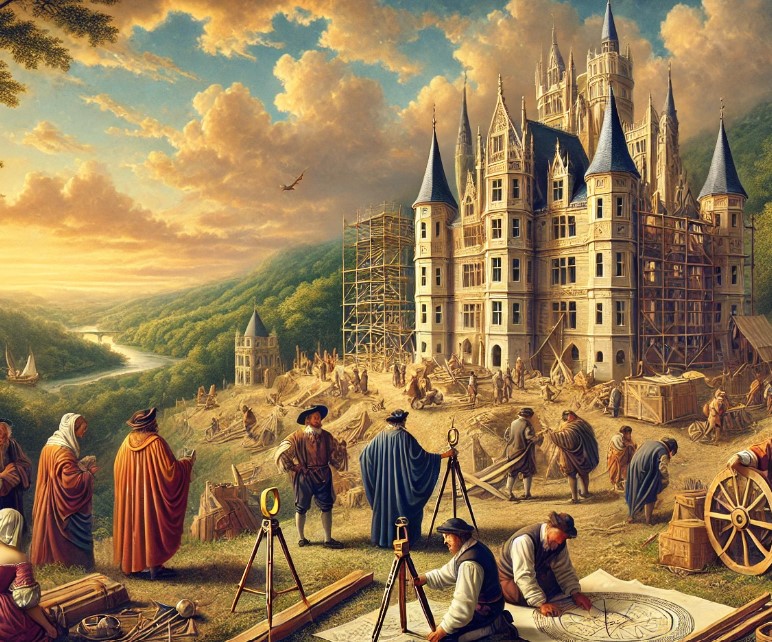
Once upon a time, a rich man decided to build a grand castle. He was magnificent, driven by principles, and had a noble cause in mind. He envisioned artisans from the New World flocking to his castle to create a thriving society within its walls, one that would support the general public. He called this vision the Wheel of Work. He also wanted to provide a safe haven for the new occupants. Knowing this was a long-term project that had to succeed, he set off on a journey to gather the best artisans and resources.
At the start, the rich man ensured that the castle’s occupants embodied sincerity, principles, and trust. To guide them, he appointed wise and loyal advisors, gifting them a special compass called the “Moral,” designed to keep their integrity and purpose aligned.
These advisors began recruiting workers, each receiving their own compasses imbued with the same values. With these guiding forces, the workers collaborated smoothly and without conflict. However, the general public felt disheartened. They, too, wanted to be part of the castle, but they needed the advisors’ approval, which they never received.
Despite the initial success, the rich man mysteriously vanished, leaving the castle in a state of uncertainty. Rumors swirled about his fate—some said he had gone in search of greater wisdom, while others believed he had met a tragic end.
As time passed, a new man seized control of the castle. Ambitious and results-driven, he saw the old compasses as relics of an inefficient past. He flung open the doors to the public and created a new compass, which he called ‘Mediocre,’ prioritizing results and efficiency over principles.
The castle doors opened wide, and everyone scrambled to obtain the new compass. The old occupants were left bewildered, and the Wheel of Work now had different drivers. Some of these new drivers, unfamiliar with the work, craved power and privilege. They tried desperately to please the new advisors by critiquing and demeaning the existing workers, both old and new, who struggled to turn the increasingly resistant wheel.
Ambitious new drivers sought to implement changes to stay relevant, causing frustration among the wheel turners as the directions shifted with every movement. The new drivers, many of whom lacked experience, were more concerned with their status than the well-being of the castle.
The older artisans, burdened by blame and disillusioned by the changes, gradually began to leave. The mediocrity compass ensured that every new direction was imposed on the workers, who grew increasingly cynical and exhausted.
One fateful day, the wheel stopped turning altogether because the drivers didn’t know how to operate it. The castle, once filled with promise and purpose, now lay stagnant. The new man and his advisors, having achieved their short-term goals, moved on to a new project, leaving behind a once-thriving castle with a wheel that no longer turned.
As the sun set on the abandoned castle, whispers of the rich man’s return began to spread. Some believed he would come back to reclaim and restore the castle to its former glory, while others thought he had moved on to grander dreams. The fate of the castle and its people remained uncertain, shrouded in the mystery of what once was and what could be again.